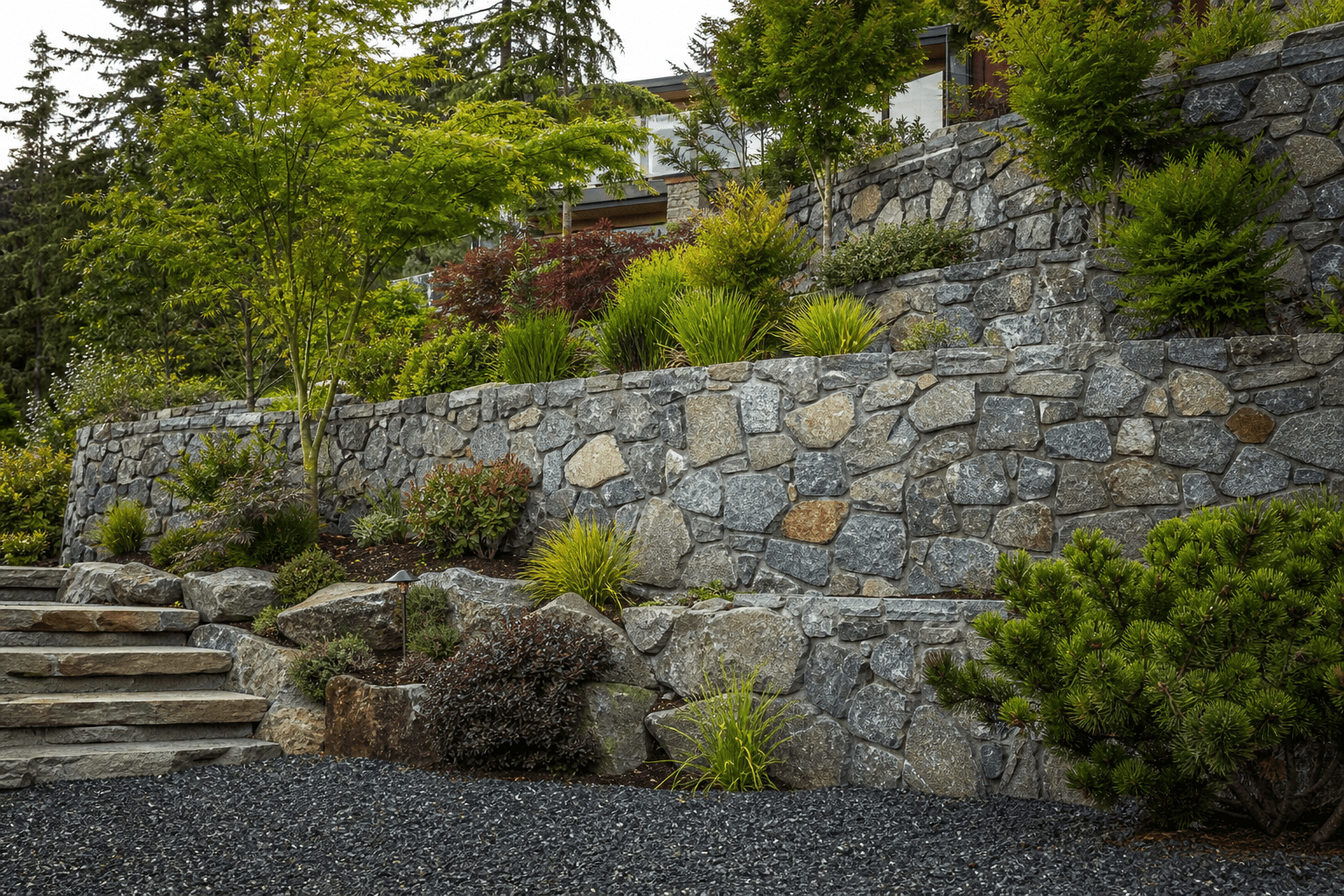
Retaining walls are one of the most requested masonry projects across the Fraser Valley — and one of the most frequently done wrong. The combination of sloped lots, clay-heavy soil, and BC's wet winters creates real demand for walls that hold back earth and manage water. But a retaining wall that looks solid and is still failing structurally is a common outcome when the prep isn't done right.
Before you plan any retaining wall project in Abbotsford, Mission, Chilliwack, or the surrounding area, here's what actually matters.
Drainage is not optional — it's the whole job
The most common reason retaining walls fail in BC is hydrostatic pressure. When water saturates the soil behind a wall and can't escape, it pushes outward. A wall that looks perfectly solid in August can be leaning by March.
Proper drainage behind a retaining wall means one or both of the following: a layer of crushed gravel backfill (at minimum 300mm wide) that lets water move freely, and a perforated drainage pipe (weeping tile) at the base of the wall that carries water away to a daylight outlet or into a catch basin. For anything over about 1 metre in height, both are typically needed.
We include drainage in every retaining wall we build. It's not an upsell. Without it, the wall's lifespan is measured in years, not decades.
Height determines whether you need a permit
In Abbotsford and most Fraser Valley municipalities, retaining walls over 1.2 metres (about 4 feet) require a building permit. Some jurisdictions also require an engineer's design at certain heights. The rules vary slightly between Abbotsford, Mission, Chilliwack, and Langley, so it's worth confirming before you start.
We know the requirements for the areas we work in, and we'll tell you upfront whether your project needs a permit and what's involved in getting one. Building without the required permits creates problems at sale and can result in orders to remove the wall — at your expense.
Choosing the right material
The three most common retaining wall materials in our area are natural stone, concrete block (including segmental retaining wall block), and poured concrete. Each has its place.
Natural stone — fieldstone, granite, or basalt — looks best and lasts indefinitely when built correctly. It's the most labour-intensive and typically the most expensive, but for walls that are highly visible or part of a landscaped yard, it's worth it. It's also the best choice for dry-stack applications on lower garden walls.
Concrete block — including engineered segmental retaining wall systems like Allan Block or Unilock — is engineered for retaining applications and is often the best choice for taller walls where consistent batter (lean-back angle) and structural integrity matter most. It's faster to build and typically more economical than natural stone for utilitarian applications.
Poured concrete makes sense for commercial applications, very tall walls, or situations where the wall doubles as a structural element of the building. It requires forms and more equipment, but it's the strongest option for heavy-load applications.
For most residential retaining walls in the Fraser Valley, natural stone or concrete block — properly built with drainage — is the right answer.
What a proper site assessment looks like
Before we quote any retaining wall, we want to understand the slope angle, the soil type, what's directly above and below the wall, and where water currently flows on the property. We look at whether there are underground utilities to watch out for, and whether any trees near the wall will affect the footing long-term.
A site visit takes less than an hour and it changes what we build. If your property has a slope that's been bothering you, or if you've had a wall fail, give us a call. We'll come out, look at it, and tell you what it actually needs.
Have a masonry project in mind?
We serve Abbotsford and the Fraser Valley. Give us a call or fill in the form for a free site visit and quote.
Ready to Talk Masonry?
Call us or send a quote request. Free site visit, clear written quote.
Licensed & Insured · BC Certified Masonry · Abbotsford, British Columbia